This transcript was generated from the episode audio and may contain minor errors.
[Music]
Welcome back. This is Chris Guillebeau for Side Hustle School. I'm so glad you made it because we're kicking off a brand new week, leading up to episode 500 early next week. Now we like to always start with a really strong story on Mondays, at least for those who are listening in real time. You know, we do the weekly recap on Sundays, then we start a new week.
And it turns out that more people listen to the Monday episode than any other episode during the week. So we try to make sure we have an especially strong story. And today, of course, we do. This story is closed to my heart for at least three reasons. The story is called "Flipping 101," the college textbook edition.
And the first reason is it features a guy who's originally from Ghana and then immigrates to the United States. I used to live in West Africa for several years on board a hospital ship, or at least right off the coast of West Africa. And we were in Ghana for about four months. So I know that country quite well. And it's fun to focus on someone coming from that part of the world.
Second reason is this guy's side hustle is about textbook reselling or flipping. He actually does really well with it, makes five figures in a pretty short period of time. And I like this because back when I got started side hustling 20 years ago, I was also reselling or flipping things. And I did some textbooks as well. I didn't really specialize in it the way this guy did.
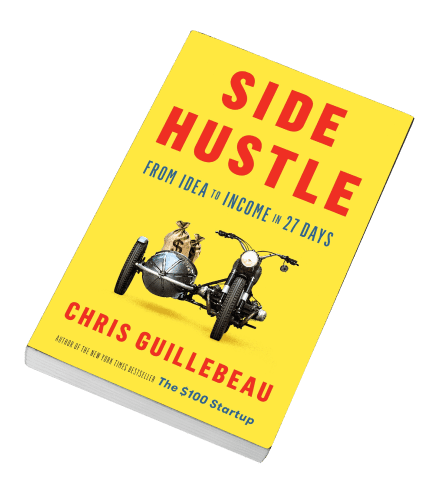
But I do relate to this kind of side hustle. It kind of has this little throwback element nostalgia for me. And number three, this guy actually read the $100 startup, which was part of his inspiration for the business. That is a book I published about six years ago. So I'm happy to be a small part of that inspiration.
Although I have to give him credit because he beat me by $80. His startup costs just $20. So we'll be on the lookout for the $20 startup from him. And in the meantime, this episode will flip your lid. It's a college student with a new family to support who reads between the lines and turns a $20 startup into almost $70,000 within two years.
Like I said, it's a good one. So let's say thanks to today's sponsor and then on with the show. [Music]
Let's face it, college is downright expensive. Between increases in tuition and the necessities of living close to or on campus, students and their parents are often desperate to find ways to trim the fat on higher education. One of the most surprising expenses, at least for a lot of students, is textbooks, which tend to cost way more than most other books.
When you're hoping to cut costs, there's often no easier way than to look outside your favorite money-hungry university bookstore. And if you've been listening to the show for a while, you know that where there's a problem, there's a side hustle just waiting in the wings. That's where our story begins today. And ironically, it all starts with a book that you're not likely to find in your typical university bookstore. Much to my annoyance and disappointment, you could say that that book is a bit unconventional.
But hold on a moment, let's talk about today's featured case study. Marcus Cusi found himself between a rock and a hard place. He was a full-time student at a university in Vermont, heading toward a promising degree in computer information systems. But money was tight. You see, Marcus had recently immigrated to the US from Ghana in West Africa.
When he wasn't cramming for exams, he was working part-time manufacturing furniture and providing IT assistance at the university. Oh, and he was also a new father. His wife, Ashley, stayed home with her daughter so that they didn't have to pay for childcare, another outrageously expensive industry, by the way. And Marcus was the main breadwinner despite also being a full-time student. There had to be a better way to make some money and that's when he stumbled upon the $100 startup.
Within its pages, he read about everyday people who were taking small amounts of money and turning them into larger amounts of money. It was exactly the kind of motivation that Marcus needed. Since he didn't have much cash to spare, he took $5 each month for four months. That's right, $5 a month for four months and set it aside for his startup costs. Those costs totaled, well, I guess you can add it up, $20.
And then he got to work because unlike some of the people he read about in the case studies from the book, Marcus needed money like yesterday. That's when he discovered the wonderful world of reselling. Not only was it low risk, it was something he could start right away, a timeframe that was appealing. This version of reselling was called flipping. Buy something at one price, resell it for another and preferably a higher one.
It was pretty simple. All he needed was something to flip. Marcus knew if you're gonna resell something, you had to A, make sure that what you were selling was in high demand and B, know your product like the back of your hand. Well, from his own experience, Marcus knew that college book prices are a common pain point with university students. If inflation continued to drive the price of textbooks sky high, cheap textbooks were never gonna stop being in high demand.
Now here's a fun fact for you, by the way, the average cost of college textbooks has risen four times faster than the rate of inflation over the past 10 years. And who knows more about textbooks than a college student? It seemed like his best bet. Marcus began his hunt where every resourceful college student finds themselves when it comes time to purchase books. That location was a little website called ebay.com.
With that $20, he purchased two books and turned around and sold them almost immediately for $70. The experiment worked, but was it sustainable? Instead of pocketing that initial profit, he reinvested it in more books and created an Amazon seller account. As he said, eBay was fine for one and done transactions, but the rate that you end up selling is mostly driven by the consumer. On Amazon, you have more control, including the ability to set your price, which means you can set your profit margin.
Within his first year of flipping textbooks on eBay and Amazon, Marcus pulled in $20,000. And in year number two, he was just below $50,000, a total of $70,000 in two years. Over the course of those two years, Marcus flipped almost 5,000 college textbooks. It all started with that $20 saved in $5 increments across four months. Now, at this point in the story, you may have some questions.
You might wonder, for example, how did he manage to score books so cheaply? And how did he know which books would sell? Well, you'll never guess what's coming next. I'm gonna tell you. Marcus realized that many students didn't actually know the value of their books.
They'd buy their books from the bookstore only to find later that either the bookstore wasn't planning on selling them next term, or were only willing to accept them for much, much less than they originally purchased them for. In other words, there were a lot of students who needed to sell books who also had a problem. And what's a broke student to do with his excess of seemingly worthless books? Well, you sell them on eBay, of course, and that's where Marcus came in. He found that students are often desperate and incredibly motivated to get rid of those books.
When he found a book he wanted to purchase on eBay, Marcus discovered he could reach out to the seller directly with an offer, thus going outside the auction process. He says that the impatience of youth often worked in his favor. And he'd use this technique early in the bidding when the bids were low. And that made his offer look more desirable in comparison. Okay, so now for the second question, how did he know which books would sell?
Well, it's not magic. It's actually pretty simple. First, Marcus chose to specialize in books for chemistry, biology, and math, because he noticed they were the most in demand across the board. Second, he learned to pay attention to Amazon.com's sales ranking system. When Marcus would find something promising on eBay, before he made a purchase, or before he contacted the seller, he'd head straight to Amazon to check its sales rank.
And for every book that's sold on Amazon, by the way, you can look and see what the sales rank is. This is public information. So that was an easy way for him to determine whether or not it was high in demand and thus potentially a worthwhile investment. Just to put some numbers to it, Marcus knew that if a book had a sales rank under 100,000, it meant that that title was sold at least once a day. And any title with a sales rank under 75,000 was being purchased with consistency.
So Marcus knew that those titles were well worth flipping. Now, what were the challenges with this hustle? Because of course it wasn't all poetry and prose. Obviously a big success, but at the same time, flipping 5,000 textbooks is no small project. Marcus got to know the employees at the post office on a first name basis, which was fun at first, but then he realized he was spending a lot of time standing in line.
He also found that after a while, he felt he was spending more time chasing bids on eBay than chasing his own kids around the house. So when he graduated from the university and started working as an IT business analyst, suddenly there was a bit more room to breathe for the Coosie family. Marcus gradually stopped reselling textbooks and took on new projects that would allow him to be more present at home. Among other things, he started a resource blog complete with a podcast. He did that together with his wife, Ashley, and it specifically focused on newlyweds.
The textbook side hustle had proved to be a much needed lifeline for him and his family, it provided them with a way to pay their bills and save up an emergency fund, which was something that seemed impossible in earlier days. When the washer or heater broke, it was annoying, but not the end of the world. Speaking of endings, this chapter may have concluded for our resourceful side hustler, Marcus, but the next is just beginning. And whatever happens, I'm sure it will be a real page turner. [Music]
Awesome, well, I love this story so much.
$20,000 in net income, year one. Never having done something like this before. I mean, it really is the kind of side hustle where you can experiment and learn as you go, it's low risk. A $20 startup here that turns into $70 on the first sale and on and on from there. This is kind of time intensive, so it's not for everyone out there, but if you're trying to do your first hustle, if you wanna do something where the worst case scenario is that you lose $20 or $100 or whatever it is, reselling is really a great sandbox.
You can play in this sandbox and if you learn a few things, just like Marcus did, you get paid for your experiments. And I also had a note specifically about reselling textbooks as compared to reselling other items. Perhaps not surprisingly, reselling textbooks is a seasonal business in the sense that the busiest period is always gonna be at the beginning of each school term. So Marcus paid attention to this and he would prepare for the overachievers who came to their first class prepared. For those students, he would have books listed in advance.
So for students who were beginning in the fall, he would sell them their books in the summer. And then he would catch those who were scrambling to get a book at the last minute in the fall after classes had already started, which was perhaps a larger market. He said that was a pretty predictable cycle. So he could just plan to spend a lot more time on the business during those periods and then less time during the other months. All right, well, I hope you enjoyed this story.
I enjoyed bringing it to you. We've got a lot more coming up. Don't forget, inspiration is good, but inspiration with action is so much better. Today's flipping show notes are at sidehustleschool.com/492. That is episode 492.
I'll be back tomorrow with 493. My name is Chris Guillebeau for Side Hustle School. [Music]