This transcript was generated from the episode audio and may contain minor errors.
[Music]
Hello and welcome. This is episode 415 of "Side Hustle School." I'm your host, Chris Guillebeau. Do you have a favorite inspirational quote? Inspirational or motivational or something that has meaning to you? I have several favorites.
I was thinking recently of this quotation from Nelson Mandela, "It always seems impossible until it's done." And that reminded me of another phrase, "The impossible will take a little while." I'm not sure who the first person was to say that. If it's you, great quote. But I think my overall favorite is what I used in my email signature. It's what I've used for 10 years. It's a quote by Alan Keatley.
And it says, "Once in a while, it really hits people that they don't have to experience the world and the way they have been told to." That's kind of the underlying philosophy of a lot of things I do, beginning with the art of nonconformity, continuing today with "Side Hustle School" and other projects. And why am I talking about inspirational quotes? Well, it's because today's story features a college student who turns his inspiration into a profitable business, motivating the masses with positive quotes on fun sticky pads. He also ends up turning down a career in banking, at least for now, to explore the side hustle life. Let's say thanks to our sponsor and I'll tell you how it works.
[Music]
Michael Russo was going to college just outside of New York City, where he had his sights firmly set on Wall Street. Beginning with an internship at Morgan Stanley, he set off on his chosen career path in search of security and prestige. Not to mention what he hoped would be a good salary, but things were about to take a different turn. You see, ever since starting college, he'd had a seriously packed schedule. We're talking seven classes at once while doing three extracurricular activities and that internship.
Time was short and scarce and Michael needed to keep up the motivation. How could he do that? Well, for him, it was positive inspirational quotes. He was scribbling them everywhere, surrounding himself with sticky notes. Except he couldn't just call them that, he decided to call them sticky quotes.
And could this be more than just an inspirational tool for himself? The first step was to validate his idea. Michael made a test version by putting six sticky notes on a sheet of thick paper and running it through the printer in his dorm room. Using these as a prototype, he got feedback from other students, as well as the people he worked with for his internship. In particular, he focused on asking three questions that would guide his decisions on pricing.
What would be too inexpensive for this product? What would be a fair price for this product? And what would be too expensive for this product? The answers to those questions provided him with a strong understanding of the market and a good idea of the ideal price point for this product. Meanwhile, he took a chance on entering a business competition at school and won first place, which came with a $5,000 award.
How about that? That money went towards professionally printing the first batch of sticky quotes. This was not as easy as making that prototype from his dorm room, because there's only a handful of printers in the country who can print pads of sticky notes where each sheet is different. He finally found a printer in Minneapolis who could get the job done, and together they created the very first packs of sticky quotes. So now with a fully fledged product in hand, he set out to sell sticky quotes across America.
He launched his Shopify website and also put the product up on Amazon. In three months, he even got 20 different independent gift shops along the East Coast to be his first wholesale buyers. How did he do that? Well, he just asked, over and over. In between tasks for his internship, Michael was pounding the pavement, going door to door between local gift shops in New York.
At night, he'd work on his website, and before long, he was selling both to consumers and businesses. For the first 18 months of this hustle, Michael didn't pay himself. It was just what he calls straight sweat equity. But now that sticky quotes is profitable with annual revenue of around $40,000, he takes a modest salary and reinvest the rest. Amidst all this hustling, Michael has learned a couple things about what's important and also what's not when you're doing something like this.
He believes that demonstrating your concept to real life people is the most important. Ask them questions and really listen to the answers. Also, once you have actual buyers, ask them too, what do customers care about? The answers to these questions have directly informed sticky quotes, price point, and packaging. He says it's also important to surround yourself with mentors and advisors.
His mentors have included his college professors as well as contacts through his college entrepreneurship club. What's not important, Michael says, is worrying about patents. We just talked about this recently on the show. He's seen people spend thousands of dollars in five years waiting for a patent, only for another company to launch and sell the same idea in half the time. As he puts it, a $50 million idea is worth absolutely nothing in your head.
Today, Michael's side hustle has its own side businesses, two of them, and they are both a different kind of sticky. After seeing the success of food and drink vendors at the street fairs where he'd been selling sticky quotes, he launched All American Donuts and Wild Bill's Old Fashioned Soda Pop Company. We'll have to save those stories for later. Meanwhile, he continues to grow sticky quotes and hopes to make it a household name. Since launching online and in gift shops, sticky quotes has found a B2B market focused on custom pads for companies, even for influencers like Gary Vaynerchuk, and who knows, maybe side hustle school, in addition to selling direct to consumers through his website and on Amazon.
For now, Michael's career in financial services, that thing he thought he was going to school for, is on hold. He's having fun and making money on his own. In the future, he might work towards beginning a more traditional career, or he might go to graduate school, or he might start yet another business venture. Still, no matter what he has coming down the road, this looks to be one side hustle that's sure to stick around. Well, I admire the hustling spirit.
Congrats to Michael. I gotta go get some sticky quotes and put them up in my office. And just a quick note on the model of proof of concept. So this is a phrase that's used a lot in the startup world, or if you're manufacturing something, or if you have significant costs, if you're inventing something, the idea is that before you invest a lot, before you really take it to market, you actually go out and see, like, is it gonna work? Can I validate this idea?
Can I have so-called proof of concept? Well, the reason I wanted to mention it is because this can be something that's different in the side hustle world. If you've listened to more than a few episodes of the show, you already know that there's no way some of these ideas could be validated before the person started them. So in other words, they weren't able to have proof of concept, but they went forward anyway. The proof came through the practice, actually, not through the concept.
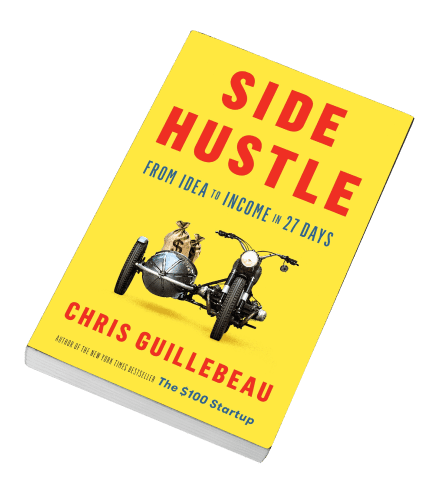
So just keep that in mind, because if you're gonna make a significant investment, if the project you have in mind is gonna require a lot of steps, there's a lot of complexity to it, and you feel like you're taking some kind of risk, then yes, maybe you do wanna do everything you can to validate the idea before you proceed. But if you're using the side hustle method, from idea to income in 27 days, first of all, you might not be able to do that. As I said, there've been so many stories we featured in which it would be impossible to prove it in advance, but also you may not need to. Anyway, Michael's doing a great job. I just wanted to provide some balance on that point, 'cause I don't think everybody has to have proof of concept.
And for you over there, wherever you are, remember, inspiration is good, but inspiration combined with action is so much better. Today's show notes are online at sidehustleschool.com/415. That's 415. If you've got a comment or question for the show, give me a call. The Hustle Hotline is 8449 Hustle or 844-948-7853.
Thank you for listening. I hope to catch you again tomorrow. I'm Chris Guillebeau for Side Hustle School.