This transcript was generated from the episode audio and may contain minor errors.
[Music]
What's up friends, listeners, community. I'm so glad you're here. My name is Chris Guillebeau. I am the host of Sidusill School. For the past 1,415 days, I've been bringing you different stories and case studies, as well as questions and answers, archival throwbacks, all kinds of fun stuff, including this new classroom series.
Well, I guess it's not that new. We started it at the beginning of 2020, which of course now feels like, I don't know, 10 years ago or something. But I have the privilege of bringing you these stories and commentary every day. And it really is such a privilege. So thank you for joining me for that.
Everybody who listens, wherever you are in the world, whatever your background is, whatever your day job situation is, everyone is united by this desire to create more income for themselves, especially apart from that paycheck from your employer, so that you have more freedom, more options to do more of what's important to you. That is the shared value of this wonderful community. Now, every other Monday, this is the classroom feature, we look at a specific topic related to starting or growing your project. If you would like to check out any of the archives, just hop over to the classroom page, sidehustleschool.com/classroom. On this page, you can scroll back, take a look or a listen to anything you might have missed or that seems particularly relevant to you.
And I always encourage you to use your time well. Some of these topics are quite specific, or they're quite basic, depending on your knowledge level, your experience. So for example, if you already have a website and you understand WordPress, then you might not need to listen to an episode about, here's how you use WordPress. Keep in mind, we still have two new stories or case studies every week, along with all the interactive new features, such as Q&A and Throwback Thursday. So I really do try to make sure there's something for everyone out there, or at least everyone who identifies with that shared value.
And today, let's look at the topic of troubleshooting. This is not overly specific, this is not basic, this actually applies to a lot of people. What if your idea, product or service doesn't work out? You've got this grand idea, you're really excited about it, but it doesn't quite work out the way you hope. How can you allow this to be a minor misstep instead of a permanent failure?
And better yet, how can you turn that misstep or even a disaster into positive momentum for your next attempt? I was really excited to work on this episode because I often hear from people who are encountering various challenges, obstacles, something in their path that's kind of just holding them up or making them feel discouraged, whatever the case is. And I also experienced that quite a bit myself, right? So here's my first and probably most important advice, when you have this situation, something has gone wrong, it hasn't worked out the way you hoped. First things first, face the problem.
Face the problem, accept reality, or at least embrace reality, at least see it for what it is. Don't bury your head in the sand, don't just keep trucking along thinking that something will change on its own because it usually won't, maybe once in a while it will and that's the exception that proves the rule. And then when that happens, it just kind of reinforces this belief that you should just remain stuck because something will change on its own. Most of the time it won't. And here's this quote from Andy Warhol that I really, really like.
They say time changes things, but mostly you need to change them yourself. Again, that's from Andy Warhol, can't take credit for it myself, but it's a great quote. They say time changes things, but mostly you need to change them yourself. So when something goes wrong, face the problem and ask what went wrong? Like what was that thing?
Let's try to actually get as specific as possible. Let's really try to identify what was the problem here. And you may not always be able to point to an obvious answer. Sometimes you just didn't get any traction. Like you had this idea, you were really excited about it, you put an offer out there, but nobody responded or the response was not quite what you hoped.
And you're not sure why. Maybe you have a hypothesis, but that's all it is. It's always better when you have a reason of course, but I did want to mention that sometimes you just don't know. So let's talk about when you do know. When you do have an obvious answer, you're like, okay, I can see what went wrong here.
Conduct a bit of a post-mortem with yourself. What was your mistake? Or if it wasn't your mistake, what was the circumstance that conspired to create this outcome? Was it something you did or did you just not reach the right people? And if you just didn't reach the right people, that could still be your mistake, of course.
But the point is there's nothing fundamentally flawed with the product or service. Like you feel like actually I developed this really well. It is a good thing, but I just didn't reach the right people. I didn't reach enough people or I wasn't able to communicate clearly enough, the benefits of this and why they needed it. Did you perhaps price the product or service too high?
Pricing is an art, not a science, but there are some general guidelines to follow. And if your pricing is way outside the range of what people are expecting one way or another, then they're probably not going to buy. So it could be pricing. And then maybe we should also say like, are you sure there was a market for your idea? You thought you had found a solution to this major problem, but what does the market think?
Do people out there agree that this is a major problem that needs to be fixed? Are they willing to pay money to fix it? There's all these emotional secondary layers that affect why people purchase. And the more that you study this and understand this and best of all, the more you experience it actually, rather than just like reading from a textbook or listening to me talk or anybody else, the more you experience it, then the better kind of feel or intuition you have around it. It's not strictly intuition at that point actually, because it's based on your experience.
So you have some knowledge. Now, before we go on, so that was a few different questions. I realized I gave them to you fairly quickly. Did you make a mistake or just not reach the right people? Did you price the product or service too high or too low?
And are you sure there was a market for your idea? Now, before we go on, there's one more important step in the post-mortem, and that is to identify what was good about your idea, because I highly doubt that every part of it was flawed. Even if it was a total disaster, there was probably something good in that idea. Maybe you just didn't develop it the right way or you didn't think enough about how to communicate with people about it. Could be something else, but I bet there's something good in it.
So don't throw away everything. Like even if you end up doing something totally different next, find the value in your original idea and reflect on it, because you did have something good there. I'm pretty sure. I highly doubt there was nothing at all good about your idea. All right, so that's a bit of the post-mortem.
I think it's also important to look ahead, look forward, make different decisions going forward. So we'll talk about that after a quick little break here to say thank you to our sponsor. Really appreciate them, allowing the show to be completely free to our listeners, brief message, and then let's look forward. [Music]
As I said, there was probably something good about your idea, even if it didn't work out. So don't forget about that, but also don't dwell on the past.
Never dwell on your failures. You see what you can learn from them, of course, extract that value, but never dwell on them. This situation does not need to define you, whatever it was, whether it was just a misstep or that major disaster or whatever it was. Just as I think you should face the problem, like don't run from it, face the problem, you should then actively look ahead and take action on something else. Usually the sooner, the better.
I mean, if you need to take a break, I understand, but usually it's good to, what's that expression? Like get back on the horse. Get back on the side, that's a horse. Probably get some emails about that from listeners who have English as a second language. I'm not quite sure where it comes from either, but there's a horse somewhere, you're supposed to get back on it.
Back on topic, very often what happens is you get another idea along the way. Like as you learn, gain that experience, et cetera, you get another idea. So if you got another idea, maybe that's what you do next. If not, what were your original ideas? Like when you chose this project in the first place, what other ideas did you have?
And if you didn't have any other ideas, or if you don't have any other ideas now, then all you need to do is go back to basics, which we've talked about quite a bit. Where do ideas come from? Ideas are everywhere. You should be able to have multiple ideas every day just by kind of going through your daily life. And there's a systematic process you can use to figure out what your skills are.
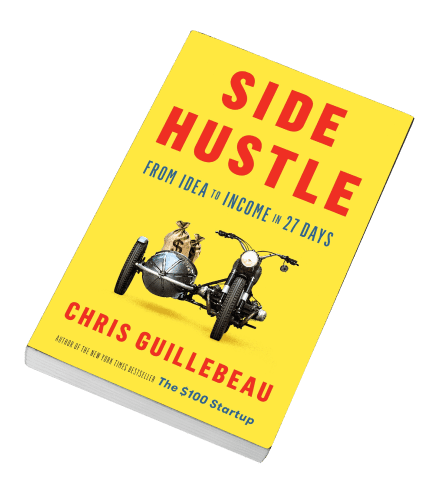
Make a list of everything you're good at, every topic you have knowledge of. Ask your friends and colleagues to add to the list. Focus on problems, focus on what bothers you, not just what you're passionate about. I've talked about this in detail many times in previous episodes, so I don't wanna dwell on this either. But if you haven't read the Side Hustle book, Side Hustle from Idea to Income in 27 Days, it also has a whole process for this as well.
So however you get there, go back to your ideas and choose your next one. Because nobody has a perfect record in the world of ideas. In fact, here's your assignment for the week. Nobody has a perfect record. So the next time you experience a misstep, consider what you could do differently next time.
And again, don't wait long to get started. Something out there is gonna work so well. Something out there is gonna be amazing. And I am cheering you on here. So I wanna hear about that when it happens.
Feel free to let me know. You can read notes for this in every classroom episode this year at sidehustleschool.com/classroom. This has been episode 14, 16. I'm very grateful for you. Be sure you take care of yourself today.
Check up on somebody else as well, perhaps, and do come back tomorrow. My name is Chris Guillebeau. This is Side Hustle School. [Music]
From the Onward Project.