This transcript was generated from the episode audio and may contain minor errors.
[Music]
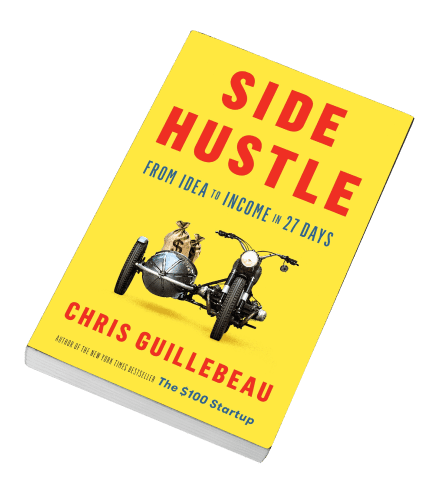
What if your biggest career disappointment could lead to your most successful business venture? That's exactly what happened to Joe Maiolano, a cancer researcher who turned a failed grant application into a homemade gen kit business that sold 75,000 units and changed his life completely. Also, it's probably a lot more than 75,000 units. That's the number that we had a few years ago. I wrote a book called Side Hustle from Idea to Income in 27 Days.
It's available wherever books are sold, including an audio version. And that's the template that we're using for this series. I'm gonna take you through the key steps of starting a new hustle in 2025 or whenever you're listening, along with listener stories and examples like this one. And for the first half of the year, we went through the 27 steps in the book. In the second half, we're looking at more detailed case studies so you can understand how people apply this framework.
This was a pretty cool story. This guy, Joe Maayano, he spent years as a dedicated cancer researcher. He was pursuing grants, conducting studies that he hoped would contribute to life-saving treatments. So his work was meaningful, but sometimes it was financially unstable. He was dependent on grant funding that was increasingly competitive and difficult to secure.
Also, sometimes you would apply for a grant and not hear back for six months. So you don't know what's gonna happen. Do you have any income you can rely on, et cetera. The breaking point came when his latest grant application was rejected, leaving him without funding for his research and facing an uncertain future in academia. He was 35 years old, found himself questioning whether the traditional academic path would ever provide financial security.
So he was like, well, what else can I do? I've got this time of uncertainty in my life. And his friend Jack suggested they try making gin at home, gin, like the liquor, the alcohol, using a distillation kit that Jack had received as a gift. And what started as this weekend distraction became a whole hobby, a whole hobby, eventually a business. Joe was intrigued by the chemistry involved in distillation and the creative possibilities of experimenting with different combinations.
So they kept refining their techniques. They got better and better at it. And friends started asking if they could buy kits to make their own gin at home. Eventually, Joe and Jack were like, maybe we should do something about this. But here's the thing.
The biggest challenge they faced was legal complexity. Home distillation of alcohol is heavily regulated. Like you can do it yourself, but you're not supposed to go out and sell it, at least without going through pretty complicated process. So they initially assumed this would make this whole business impossible for average consumers. But then they found a clever legal workaround.
This workaround changed everything. Distilling alcohol at home is regulated, but creating gin by infusing neutral spirits with botanicals is perfectly legal in most jurisdictions. This is basically called compound gin production. It creates authentic gin without requiring distillation equipment or special licenses. So again, it's a workaround, basically.
They realized they could create kits that included high quality neutral spirits, carefully curated botanical blends, and simple infusion equipment that would allow customers to make gin at home completely legally. This eliminated regulatory barriers while providing an authentic experience. So once they made this understanding, they're like, let's make an actual product. Let's make a product that we call the homemade gin kit. This kit design focused on simplicity.
Each kit included those pre-measured botanical blends, the high quality neutral spirits, infusion equipment, and most of all, at least for some of us, detailed instructions that guaranteed success even for complete beginners. They tested the product extensively with friends and family. They used feedback to refine both the combinations and the instruction clarity. Interestingly, the testing phase revealed that customers value the educational aspect as much as the final product. Like people just enjoy learning about gin production and the botanical flavors.
Finally, they were ready to go to market. What happened? Well, let's take a quick break. When we return the results of Joe and Jack's launch strategy, and perhaps more importantly, how this might give you your next idea. What might you do for your side?
So that's what I'm always encouraging you to think about. So quick little shout out to our sponsor, Ad Break, and then results and application. [Music]
Joe and Jack's launch strategy leveraged digital marketing and the growing craft spirits movement. They launched this business online. They targeted craft cocktail enthusiasts and home hobbyists who were just interested in doing different things.
You know, if you're interested in artisanal stuff, then you are in the target market. The timing was fortuitous. When they started this, the craft spirits movement was gaining a lot of momentum. Consumers were increasingly interested in understanding it more. And so Joe and Jack's kits provided this accessible entry point into a world that had previously seemed exclusive and complex, as well as off limits, perhaps because of those regulatory issues.
So this helped a ton. And within three years, they had sold over 75,000 gin making kits. This is a seven figure business, like a weekend hobby into a seven figure business, provided Joe with far more financial security than his academic career had ever offered. And in fact, the business success allowed him to completely transition away from grant dependent research work. He can now focus on product development and business growth that he controlled directly.
They also really delved into the educational component of those kits since they'd noticed that was popular. So they started doing some online workshops, advanced botanical collections and partnerships with distilleries who were interested in education. So a ton of success there. The legal workaround was a crucial point. Once they discovered that, they're like, nobody's done this before because they haven't figured it out.
So how might you apply Joe's pivot approach to your own career transition? And of course, everybody's story is unique and such. But I think the first thing is you identify how your professional expertise could solve problems in completely different industries. Sometimes the most valuable applications exist far from your current field. Like whatever you're doing now, you have a skill that can be applied in a different way.
Next, consider the technical barriers that prevent others from entering a market you're interested in. Just like what Joe did. These barriers can create opportunities for somebody out there who understands how to work within or around the constraints. Next, of course, do some testing. Joe and Jack did a lot of concept validation and then product development before actually scaling production.
And then finally, leverage your professional credibility to differentiate your approach from generic competitors. Your expertise background can justify that premium position and build trust. So how might that work for somebody else? Well, an engineer could develop electronics education kits that teach circuit design, perhaps through hands-on projects. A biologist could create mushroom cultivation kits.
What about coffee roasting kits that teach the science behind flavor development? And these are just a few examples and you could go in lots of different ways. The whole point is to identify a market where your professional expertise can create an educational product that solves a technical challenge other people are unable to address. I hope you'll do that today, or at least think about it. Think about what might be next for you.
And I hope you'll also take one step to get closer to a goal that's important to you. That's what we're all about here on the podcast. As always, it's better to have a simple idea you can start right away than a brilliant idea that never launches. I wish you every success. I hope you'll also subscribe or follow to the podcast for more new episodes every day.
My name's Chris Guillebeau. You're listening to Side Hustle School. [Music]
From the Onward Project.