This transcript was generated from the episode audio and may contain minor errors.
[Music]
Side Hustle School, what's up? Welcome back, this is Chris Guillebeau. Excited to have you here for episode 269. I am in New York City going on to Washington DC tonight, Philadelphia tomorrow, onwards from there. You can always see where I'm at or come out to join me by looking at sidehustleschool.com/tour or following me on social media.
It's 193 countries on Instagram, 193 countries. I've been doing lots of Instagram stories every day, kind of talking through the process of being on tour or just my name Chris Gallibow on Facebook or Twitter. That's Chris, C-H-R-I-S, Gallibow, G-U-I-L-L-E-B-E-A-U. Now every day on the show, I'm telling a story of someone who has a job and is usually pretty busy yet is still able to find a way to create additional income. Not just by working a part-time job but usually by creating some kind of asset for themselves.
Most of the time by using the skills they already have or like in the case of today's story, acquiring some new skills based on something they were interested in. And most of the time these stories are actually true. Just kidding, they're actually true all the time. These are real people making this happen for themselves and my hope is that the stories will serve as a model for your side hustle. Today's story is about a computer teacher who turns $2 of PVC plastic into $800 a month making bows and arrows.
Or now that I look at my notes, I see he just makes bows but they're the kind of bows that go with arrows. You can't have one without the other and that story's coming right up. [Music]
Jeremy Bayes has been a Robin Hood fan since he first read the Howard Pyle novel in fourth grade. It's also what inspired his interest in bowmaking. And now the computer technology instructor is turning $2 of PVC material into $30 in profit over and over from his bowmaking craft through sales at Renaissance Fairs on eBay and his own website.
How did this come to be? Well, in his youth, he would search his yard for sticks and branches to fabricate his own makeshift bow until he had saved enough lunch money to purchase a used fiberglass bow. After high school, a lack of time caused him to set aside archery, although the interest always lingered in the back of his mind. After the birth of his first child, Jeremy's financial situation was strapped. Every penny in the budget went for food, diapers and childcare.
Then while browsing online one day, Jeremy found a primitive archery website featuring English longbows. He longed to get back into archery, but since money was tight, he couldn't afford the $100 investment. Yet that didn't stop him because he was resourceful. Jeremy emailed that site's owner and asked if he could barter something for a bow. It just so happened that the bowmaker, who was 65 years old at the time, was looking to establish a better online presence.
And Jeremy was just the person to help. He got to work further developing the bowmaker's site and the financial arrangement that they came to was that for every bow Jeremy sold, he got to keep 20%. When a bow sold, he would email the bowmaker with the details and forward 80% of the funds through PayPal, keeping 20% for himself. The process took about 10 minutes per order and even less as time went by. And Jeremy was happy for earning those $20 commissions for 10 minutes or less of work.
It was easy money, money that allowed him to treat his family to an evening out or just pay for more diapers. And things followed this progression for several years. When Jeremy needed extra money, he would scale up adding more bows to the website. And when he needed more time, he would just let the site coast. The simple side hustle worked well until his partner retired.
He could no longer send off orders and consider his job done. If he could figure out how to make the bows, he'd make more money, but that was easier said than done. When his partner closed up shop, there were three pending bow orders. The partner emailed him step-by-step directions and Jeremy went to work. Not surprisingly, the bowmaker had things down to a science, making a bow in about an hour.
But Jeremy's first attempt took two weeks and several broken pieces of wood. He refunded two of those three outstanding orders and shut the website down. Three years later, Jeremy saw a YouTube video of a guy building bows from PVC sprinkler pipe, who is also the author of a book called "The Impossible Bow," soon to be a breakaway bestseller after being featured on "Side Hustle School." Jeremy watched the videos, bought the book and went to work. After a few attempts, he found he could make a PVC bow in about 40 minutes. He decided to get back to his side hustle.
Jeremy restarted his bow making, creating both wooden long bows as well as those PVC bows. Startup costs were minimal. He bought a heat gun for $15. The PVC bows could be made for $2 in materials. He registered his business with the state through an online forum that took a few minutes.
And his skill at bartering also continued to serve him well. He had the idea that a local Renaissance fair might be a good market for his new bows. When he inquired about the cost of a booth, he learned it was way out of his price range at several thousand dollars. So he asked about bartering. He learned that they had a long bow contest and were looking for prizes for the winning archers.
Jeremy volunteered to make new bows for the winners of each division in exchange for booth space for two weekends. He bought a used pop-up tent at a secondhand store and decorated it with Renaissance themed dollar store fabric and fake vines for about $100 altogether. You might call it the Made in Taiwan Renaissance. Jeremy now works a few weekends a year at these fairs, selling his bows and assisting other archers. He says it's a great arrangement because he gets to do what he loves, he has fun and he gets paid for it too.
And on top of those event sales, Jeremy's also actively taking orders through his website, which he developed using basic HTML and PayPal. He tried some other solutions but dropped them when he found them harder to maintain. He now makes about $800 a month selling the bows at local festivals. When he's not there, he's got his website, he's also selling on eBay to make a few hundred dollars more. As for the best part of the side hustle experience, well, he says it was the spending money.
It's given Jeremy a layer of security for when he's had a family emergency and also the opportunity to splurge now and then. He hopes to expand his hustle further by getting involved with more fairs and possibly branching out into something called archery tag, which sounds a little scary to me, but I guess I don't know much about it. In addition to selling medieval and oriental swords, another of his hobbies. Stay tuned for the PVC sword episode coming soon on Side Hustle School. [Music]
So I was reminded of something when I was working on this story and I came across this part where he was just forwarding those orders to the partner who made the bows for several years.
And at first I thought, well, what if he had learned to make the bows sooner? Like wouldn't that have been better? And maybe it would have been, you never know. But it also made me remember that sometimes a side hustle can serve you throughout life in different seasons. So for this guy, for a number of years, it was actually really simple to just kind of pass on those orders, make 20 bucks each time.
And when he had time, he could sell more. When he was busy, he could scale back. And then after the partner retired, he had no side hustle or at least not this one for several more years. But then he goes back to it and learns to make his own. So at some point earlier on, he had learned these e-commerce skills, which are pretty basic in terms of being able to take in orders, pass them on.
And then later he combines that with this new skill he acquires from watching YouTube, how to make bows out of this PVC material. Kind of reminds me of the story we did about a guy in South Carolina who learned to make candles by watching YouTube and is actually selling them on Amazon and doing really well. I guess the point is to figure out what is best for you. And that's why learning the side hustle way can be so valuable because it's adaptable, it's malleable. You might have a certain goal now, but a year from now or several years from now, you might have a totally different goal.
But you can still use these same skills to support whatever your mission is. That's my thought, my encouragement for you today. As I said, these stories are models for you. I hope you spend at least a few minutes today and every day doing something to get closer to the freedom that you want. Because inspiration is good, but inspiration with action is so much better.
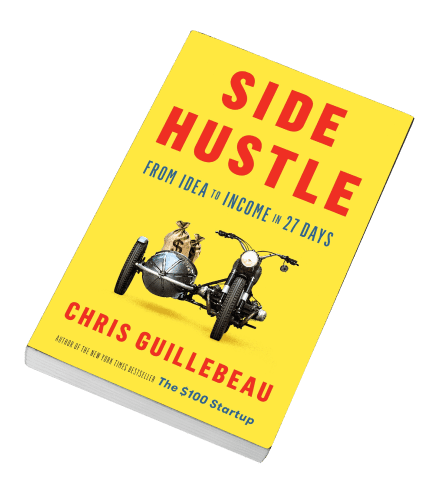
Today's show notes include links to Jeremy's bows as well as that mega best-selling book, "The Impossible Bow," now in competition with sales of the side hustle book and anything else I mentioned, how to get Renaissance themed dollar store fabric that's made in Taiwan. Well, I'm not sure if there's a link to that. You just go to the dollar store. Thank you for listening. I hope to see you tomorrow.
I'm Chris Guillebeau for Side Hustle School. [Music]