This transcript was generated from the episode audio and may contain minor errors.
Hello, hello. Welcome to Side Hustle School. I'm your host, Chris Guillebeau. Over here, we have just finished week 17 of the show. I came back from a quick trip to Korea. Jet lagged as
usual, but pushing forward. Next week, going to Chicago and Boston. Before we do today's recap, I want to give you two quick book recommendations. One book just out this week is called Captivate, The Science of Succeeding with People. This is by Vanessa Van Edwards, who runs a very popular lab called Science of People. She's also speaking this summer at the World Domination Summit. I'm looking
forward to that. In the meantime, you can check out her book. It's super practical. Lots of tips about improving your people skills. Second book is from another friend named Tish Oxenreiter. This
book is called At Home in the World, Reflections on Belonging While Wandering the Globe. Tish has traveled and lived all over the world with her family. I thought that was such a wonderful title for a book, At Home in the World. I wish I had thought of that myself, but since I didn't, I had to buy a copy of her book. Now, getting back to side hustles, we really are in the midst of a global phenomenon. I've been hearing from listeners worldwide. This concept, this notion
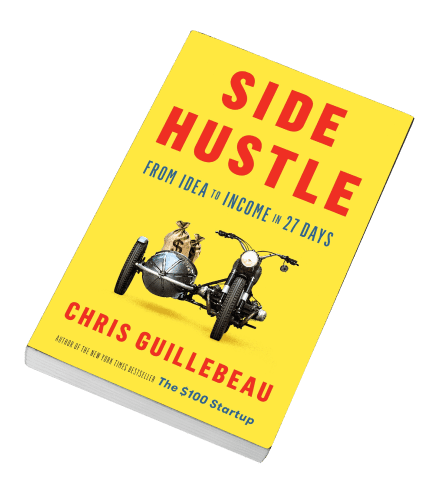
of creating security for yourself really is building more and more momentum. Later this fall, I'll be publishing a new book myself called Side Hustle, really creative title I know. As I begin to make preparations, it's interesting to have conversations with my publishers in India and the UK and elsewhere, and hear different stories about how people are applying this in their own way. When that book is out, I'll be doing a big worldwide tour. I would love for you to be part of it, and I'll tell you more about that as it gets closer. Speaking of creating
security for yourself, a side hustle is not just a part-time job. I want you to create an asset for yourself, and there's a key difference. When I say side hustle, I'm not talking about becoming an Uber driver. I'm not talking about network marketing. All of the stories featured on the show, or at least the great majority of them, are about ordinary people just like you and me who didn't go to business school. They just wanted to find a way to do something fun and get paid
for it. When you make that happen for yourself, as many of our listeners are doing, it's a really great feeling. If you haven't had a chance to have that feeling yet, it's something you can look forward to as you pursue your idea. Today, we have listener questions, a brief recap, and a look ahead to next week. Let's get started with some questions. Hi, my name is Sue. I live in Pasadena,
California. I love the show. It's a great source of inspiration and information to me. I have a question about the museum tours from episode 100. Number one, how did the museums react to this? I
would guess they might love the publicity, but just wondered. Number two, did he certify and authorize new guides? And number three, how did he teach and evaluate the new guides? Thank you very much. Hey, Sue. Thanks so much for listening. Hope to see you at Roman's bookstore sometime.
So Sue very helpfully pointed out this was episode 100 that she's asking about. A guy who's been very successful creating what he calls renegade museum tours, or museum hacks. Now, this kind of language, renegade hack, it's just kind of fun. It's like marketing language. He's not really doing anything wrong or anything the museums don't like. And in fact, one big challenge
that museums have is bringing in new visitors or younger visitors that haven't grown up going to museums. And so those people are Nick's exact target market. So first of all, he is making a connection between those people and the museum. But then second, he's not bringing them there for free. There is a ticket price included as part of the tour. I'm not sure if they get a book discount
or anything, but museum hack pays an admission cost to the museums for each guest. And in fact, last year for the Metropolitan Museum of Art alone, the company paid more than $300,000 in admission costs. So I think they were pretty happy with that. Now you also ask about the training and certification for the guides. Nick says a secret to success has been finding the right people in the first place. He looks for people like Broadway actors, stand up comedians, as well as scientists
who have a lot of knowledge. And then there is a training process. I don't know exactly how that part works. But then these guides have a lot of ownership over the tour themselves. So they actually design their own routes. So it's kind of a collaborative process. And I think a big
key is not just the training, but getting the right people in the first place. And of course, as we saw from that story, he's doing fabulously well. Thanks again, Sue. You've mentioned a couple of times the importance of business accounts for tracking our different hustles. Do you recommend having a separate business and account for each idea or consolidating them into one or two accounts and businesses? At which point in our hustle should we start
setting up these businesses and these separate accounts? Smart question. I believe that was from CJ. CJ, thanks for listening. So here's a general rule. If you're starting multiple projects and
they are completely unrelated, which is not always a good idea, but some of us do it, then it probably is good for those to be separate business accounts, not just one of them. And if you have any kind of partnership, then there should be a dedicated bank account for that. But otherwise, when you're just kind of experimenting and starting new things, the key point is to make sure that your business and personal finances are separate. So you do want to open a business bank account. But if you have three ideas, you don't necessarily need to go to the bank and open three different accounts the same day. What I do for myself is I have one kind
of general all purpose business funds account. And then for projects that are built out a bit more, or have been going for a while, then I get a dedicated account for them. So in other words, I keep all my business and personal finances separate, of course. But if I have eight different projects, I'm not necessarily trying to have eight different accounts. I hope that's helpful.
So looking back at this week, there were a couple of stories that stood out a bit in terms of listener feedback, questions and comments I received. My personal favorite episode was about the After Dark Midnight Cookie Delivery Service. It's really hard to top that. That was episode 116. I got a fun email from them as well. They said within an hour of the episode being released, they began to
get emails from listeners. So I thought that was fun. If you live in Portland, Oregon, feel free to join me in ordering cookies next weekend. Well, if you don't and you get a chance to come visit, definitely put this on your list. Aside from cookies, though, on episode 115 was about a graphic designer who turns a side hustle into an $80,000 a year project. The key point there was
about authenticity, about this advice that's sometimes given out. How do you engage online? How do you do your social media, et cetera. And the advice is always be authentic, which sounds fine. But of course, what does authenticity actually mean? And in this story, what we saw
with Michelle D'Avella was the closer that she got to being her true self and figuring out what her voice was, what her message was. It was a process of trial and error. But the more she found that authentic self, the more successful she was. So if you didn't get a chance to hear that one, you might want to go back and re-listen or listen for the first time. Coming up next week, first thing tomorrow, a story about a man under house arrest who is feeling a little bored since he can't go anywhere, ends up starting a project that about three years later is now bringing in half a million dollars in sales. So unless I'm mistaken, I think that's our first side hustle
from jail story. Feel free to send me others. Got a story of a woman who bakes dog treats. She calls her side hustle Bruno's Barking Biscuits. Pretty cool. And among others,
a feature from a guy who starts what he calls Uber for lawn care. So quite a mix coming up. By the way, if you have a side hustle and you're listening to the show, you'd like to be featured, just come to the website, sidehustleschool.com. Look at the about page. When you scroll to the bottom, there's a link that says submit your story. And that will take you to a survey where
we can get some information. My goal going forward is that more and more stories are coming from listeners themselves in response to the show. And of course, all their hard work. So let me know what you're up to. Now it's true what they say. No man is an island. I'm not the only person working on
this show. Want to give credit where credit is due. Side hustle school is recorded on location at world domination headquarters in Portland, Oregon. It is then transported by Amtrak to Brooklyn, New York and Washington DC, where it's produced at the Panoply studios. My production team is Jason De Leon and AC Valdez show notes and all kinds of other stuff are by Whitney Karinek.
My cat Libby Gillibo manages the help desk. Life advice this week comes from the notorious BIG. Never let no one know how much dough you hold. It's good advice. And we side hustle school are part of the onward imprint curated by best selling author Gretchen Rubin. You can check it out at the
onward project.com or search Gretchen Rubin in iTunes. Last, I want to thank you the listener. You're the reason I do this. It is indeed a labor of love a free listener supported show with just a single sponsor per episode. If you're enjoying the show, I'd be very grateful if you'd help to pass it on. It has grown almost entirely from word of mouth. People like you telling their friends,
posting on social, leaving reviews on iTunes. Those help a ton. Thank you so much for those who have done that. Mostly I want you to know today that you are awesome. I'm excited to hear about your side hustle story. I want you to create that security for yourself that I mentioned at the
top of the episode. So you can think of this as an investment in yourself. And hopefully it's a pretty easy investment. Episodes are uploaded at 601 a.m. Eastern time every single day. I'm Chris Guillebeau. This is side hustle school.