This transcript was generated from the episode audio and may contain minor errors.
[Music]
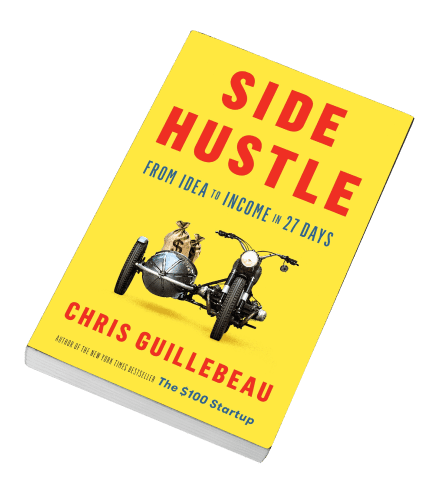
Hey, what's up? Welcome back to Side Hustle School. I'm Chris Guillebeau. We have just finished week number five and I'm having so much fun. Greatly enjoying the process of making this for you.
And there's a lot of fun stuff that's happening behind the scenes. A lot of new improvements that have already begun to roll out. You may have noticed some of them, especially if you've been to the website. So if you have been rolling along from the beginning, awesome, keep listening, lots more in store. And if you've just joined us recently, welcome.
I hope you enjoy it, but more than that, I hope it's not just entertaining. I hope the show is truly and genuinely helpful for you. A side hustle is a project you create to earn money apart from your day job. And ultimately it's all about creating more freedom and opportunity for yourself. And this is true whether you hate your job and are trying to make a big change or if you love your job and you have no plans to leave, but you just also love the idea of having more than one source of income.
That's what a side hustle is all about. And here on the show every day, there's a different story of someone who does that without quitting their job. I don't think everyone should be an entrepreneur, but I do believe passionately that everyone needs an additional source of income, if not more than two. So if you're listening to this show, you believe in investing in yourself. You believe in creating your own security through a hustle.
And the whole point of what we're doing together is to guide you along that path of starting that first, second, or fifth hustle. Also, if you are new, I wanna encourage you to go back and download the first batch of episodes. They're all short, they're action packed. You can listen whenever you like. They'll help you understand a bit more about where we're going through the rest of the year.
So several quick sections in today's weekly recap, beginning with listener questions. Now on the website, sidehustleschool.com, if you have a question for me, you can actually record your question and I might answer it right here on the show. Now, I apologize. We were supposed to have these last week too, but due to technical difficulties, meaning that I'm incompetent, we didn't have them. So I'm still incompetent, but I've surrounded myself with much smarter people.
And once again, we have listener questions. So let's rock and roll with that. And then we'll look back on this week's highlights as well. - Hey, Chris, big fan of the podcast. I had a couple of quick questions when it comes to starting my side hustle.
First, I know you've talked about Fiverr and Etsy, but I have an idea that I feel could go from a hundred orders to a few thousand pretty quickly. What do you think of sites like Kickstarter so that I could have the project fund itself and so I could get a better idea of demand before I start making it? Second, the idea would rely on images. Do you think I should copyright said images? How difficult is that process?
Or would a service like Myals or Safe Creative suffice? Lastly, do you think it's necessary or even beneficial to form an LLC or just a general business behind the idea itself? Thanks so much for the help. - Awesome questions. I believe those came from Tom in New York City.
Tom, thanks so much. - Okay, so one, two, three. First of all, Kickstarter versus Fiverr and Etsy, very, very different platforms. If you truly have something that you think could really take off, as you said, go from a few hundred orders to a few thousand orders, then I don't think Fiverr, Etsy, similar, are the best platforms to start with. Those are great platforms to experiment with playing entrepreneurially.
Kickstarter and Indiegogo and similar, much better if you really want something to take off, as you said. Now with Kickstarter, you don't actually want to prepare your listing and launch a campaign unless you have a pretty good idea about it. Now obviously, the validation is gonna come through the crowdfunding, but part of the reason the crowdfunding is gonna be successful is because people believe that you have a great idea. So something like Fiverr and Etsy, you could get started tomorrow. Something like Kickstarter, you actually want to invest a lot of time in putting together that campaign to tell the best possible story, to really think through the logistics of how people will get their items and when.
So they really are quite different. And based on just the one sentence that you said, it sounds like Kickstarter or something like that might be a better approach. Now for your second question about copywriting images. So I'll just be really quick about this. Short version is if people want to steal from you, doesn't really matter if you have a copyright symbol on your work or anything else.
You're gonna run into that issue one way or another, especially if your project really takes off and becomes popular. So you mentioned a resource I believe called Safe Creative, which I'll link up in the show notes. Yes, the short version is I think something like that would totally suffice, at least in the early stages. And lastly, you asked about forming an LLC. I've actually been getting a lot of questions about this, so we might do a longer show on it.
I am most certainly not a lawyer, but again, let's make a distinction between experimenting, playing around with a site like Fiverr, and going a bit bigger with something you're truly trying to scale. When you're just playing around with Fiverr, you don't really need to incorporate or do anything like that. A sole proprietorship is usually totally fine. If you are trying to build something a bit bigger, sometimes it is good to have a bit more legal protection. And in a lot of places, it's actually not expensive at all to form an LLC.
I just checked in my home state of Oregon, it's about $100. So again, if we're talking about a project that can go thousands of sales, you might as well spend $100 just to have that structure in the beginning. - Hey Chris, my name is Denna, and I'm calling from Seattle, Washington. I've loved listening to your podcast and consider myself one of your students. I'm constantly coming up with ideas or business models that I think would be valid side hustles, but where I often hit a roadblock is in the development.
Without computer science and coding knowledge, how does someone really hit the ground running to establish proof of concept when you need a sophisticated website, API capabilities, or an app to move forward? I've poked around freelancing sites, but it can be difficult to narrow down candidates or find someone passionate about your idea. Do you have any advice? - Jenna, thanks so much, great question. So my first response is kind of a question to you.
And I don't know the answer, it could very well be yes or no. But the question is, do you really need that sophisticated website? And do you really need those API capabilities for what your project entails? So if the answer is no, if there's any way at all to start your project with a more simple site that doesn't rely so much on technology, then that sounds better. However, it's kind of like Tom's project, maybe your idea actually does require a sophisticated website.
So if it does, somehow you're gonna need a sophisticated developer. And sites like upwork.com, which I'll also link up in the show notes and similar, can be good. But for stuff like that, you really need to know exactly what you want and be very specific about it. So if this project is more than just a short term side hustle to make some money, if it is something you're trying to build for the long term, then one way or another, you're gonna have to partner with someone or find someone who has that kind of expertise to help you along. And there are different ways to do that just as there are many different kinds of side hustles.
Thanks a lot, Jenna. Thank you, Tom. I'm so glad you guys are listening. [Music]
So I wanna focus on a couple of lessons in particular from two of the episodes. But first, episode 29 was about Dan, the hospital database programmer who creates a high end tutoring business, among other things.
Now in that episode, a number of people wrote to ask me for the link to the platform he uses. I said it in that episode, but I probably said it too quickly. So it's wizant.com, W-Y-Z-A-N-T.com, or W-Y-Z-A-N-T.com. And that was linked up in the show notes. So if you go to sidehustleschool.com, you can see notes for every episode, usually including links to anything that I mentioned.
Now, as I said, we're making some improvements. We're actually improving the show notes to expand them even further. So sometime in the next week or so, if you haven't been to the site recently, check back and you can see even more info. I wanna talk a bit more about episode 30, which was the Ohio IT director who has earned more than $31,000 setting up website hosting accounts. Now in this episode, we began to talk a little bit about finding your ideal customer and thinking really clearly about who you're trying to serve.
And as part of that, I think it's really important to breathe life and personality into your hustle, especially your website or anywhere that you talk about what you're ultimately selling. I think a lot of people have the mistaken belief that if they're selling something, it needs to be super professional, nothing personal, like a clear separation of church and state. And that's really not true, at least for most hustles. So in this example, Shannon, that Ohio IT director, her website lists her professional qualifications, of course, it shows her portfolio, of course, but that's not all. If you go to her about page, which is really well-designed, you can learn all sorts of other facts about her.
You can learn her favorite Taylor Swift song, how she goes to the gym to work off her weekend Miller Lite habit, and how she felt when she got her first client. So if you go to that and you're an outsider, you might think, whoa, too much information, who cares about this stuff? But that's exactly the point. Not everyone cares, but her ideal customers do. So please do not be afraid to show a bit more of yourself, because people who are interested in learning about what you have to offer, are probably interested in learning about you as well.
Episode 31 was that trip to the ballpark that inspired a unique fashion item, a couple who began manufacturing baseball themed sweaters. Now, a few days ago, I had our first extended cut, which if you haven't had a chance to listen to, you may want to go and check out. It's a bit of a different format than the daily story. And in that episode, I talked about the power of observation and how many hustles come about, not through extensive validation, not through any kind of quantitative measurement, but simply by paying attention. And this is a supreme example of that.
Who would have ever thought that making a sweater that looks like a baseball is a good idea? First of all, that's just kind of hard to imagine. And second of all, there's really no way to validate that without actually doing it. So one of the principles of statistical school is that actionable ideas are everywhere. You just have to learn to pay attention, and that's a learned skill.
Now, episode 32 was probably the most popular of the whole week, make $4,000 a month, renting out cars you don't own, got a lot of emails from people about that. I also heard from a lot of people who are signing up for Turo.com, and Turo is not a partner of the site, by the way. I just loved how Turo used this platform to get really creative. So if you sign up at Turo or one of the other services that does something similar, and you start leasing out a bunch of cars, let me know how it goes. And one really important point about this, this is part of the sharing economy, just like Uber or Lyft or TaskRabbit or similar, but there's something about it that's very, very different from all those other services.
And what's different is you can make money when you're not actually doing something, and that is key. That's what I'm trying to encourage you to do aside from school, not just get another part-time job. And driving for a ride share company is a great starter level hustle. It's a great entry point, but you're really not creating any kind of asset, and you have to be present the entire time to get paid. So that's why what TaskRabbit has done is so creative.
He is using the sharing economy. It definitely takes work, but a lot of the money that he earns, he earns while he's asleep or while he's at his day job or while doing something totally different. So that is, of course, wonderful. And the next two episodes were both about artists, but in a very different way. So episode 33 was about the GE engineer who sells handcrafted slate artwork to all 50 states in a number of countries now as well.
And as I said in that episode, the best thing about it for him was being able to say, no, thank you to his employer when they asked him to relocate. Now, he still liked his day job. He offered to continue in it, but he wasn't willing to move himself across the country. And because he had the side hustle that was bringing in significant income and had potential to bring in even more, that's what gave him the freedom to be able to say no. So I liked that.
And then in yesterday's episode, it was about the Seattle real estate consultant who fills apartment buildings with original artwork. And there it was really fun to see a mashup of skills, to see someone who was skilled in two different industries, real estate and art, find a way to bring them together, which is another common and potentially lucrative theme of side hustles. If you can kind of bring different worlds together and do something that hasn't been done before or connect people or connect resources like what you heard about yesterday, then you can truly create something that is both different and profitable. Well, I could say a lot more about all those things, but we have seven new episodes coming up next week. And I believe four of them, in fact, focus on services as opposed to products.
Doesn't mean that a service is always better than a product. We'll talk about that. But I wanted to give you several examples in a row of people who found a way to make something or teach something. So for example, tomorrow you'll hear all about a woman who creates a six-figure hustle in the field of fitness pole dancing. That's right, fitness pole dancing.
So if you're not familiar with that field, you're gonna hear about it tomorrow. Several other fun things, of course, as well as, as I mentioned, some more stuff we're building out as people listen and engage with the show. This week we got a shout out from the New York Post, from popsugar.com, my dear friend Gretchen Rubin, who hosts the very popular Happier podcast and is also the founder of the Onward Imprint, which Side Hustle School is proudly part of. And of course, many of you are sharing the show, too, which makes all the difference in the world to me. I am so happy to be able to do this.
There's so much more to come and I can't wait to share it with you. Thank you for being awesome. If you have subscribed to the show, the episodes will come straight to your phone, tablet, or computer, and if you're enjoying the show, be really grateful if you'd leave a quick rating in iTunes, just takes a couple seconds. And if you can go above and beyond in being awesome, you can also write a short review. That will help other people discover the show.
And in each episode, I try to mention that inspiration is good, but action is even better. I want you to take action. I want to feature your story on the show by the end of the year. So I look forward to hearing about your hustle and I hope to see you tomorrow, every day next week, with more stories and actionable ideas. I'm Chris Guillebeau, this is Side Hustle School.